Math is Beautiful —Math with kids during Corona lock-downs, even if you and math are not on…
Math is Beautiful —Math with kids during Corona lock-downs, even if you and math are not on speaking terms

I am not here to tell you that you should be doing more with your kid, doing more math, doing more long division, or any of that. However, if you are thinking to yourself that you would like to be doing more math with your kids, but you’re not sure of how, you are not alone, and hopefully this post will be helpful.
So many adults have been traumatized by math. Sometimes all it takes is one teacher who confused the crap out of you, and then forever you feel like math is confusing. But it’s not — your teacher was just confused (and confusing). Math is beautiful. Math is language. It is art. It is music. Math is nature. Math is about relationships — how quantities of things relate to one another, how patterns relate, and how things change. Playing with math can heal our relationships with mathematics, and also open space for math to be joyful for our children.
Playing with math also supports children’s success in math later on. There are foundational mathematical concepts that can easily be built through play. And even if a child is in the learning-long-division-with-this-weird-new-method stage of life (or even learning quadratic equations with this weird new method stage), building confidence around these foundational concepts gives them strong roots to really blossom with the more advanced skills. And regarding those advanced skills: you do not need to try to teach long division or quadratic equations to your child right now if that is not something you feel comfortable doing. Seriously.
The key when playing with math is to not rush to solve as many problems as possible, but to give each other space to reason, to identify and pose problems/questions, and to explore. Be open to questions from your children — and don’t rush to give easy answers. Sometimes, the best response to your child’s question is to ask them a question in turn. It can be as simple as “What do you think?” or “How could we find out?”
In my family, we have one kid who is quick to process math thoughts, and one kid who is slow to process math thoughts — so we do sometimes need to intentionally take turns. It can be helpful to have a designated movement to mean “I have a thought, or I know the answer, but I’m holding onto it to give others a chance to process.” We like putting your finger on your nose, or if it’s really hard to wait, putting your hand over your mouth. Sometimes it’s really hard to hold it in! Math is exciting.
There are a lot of ways to play with math, and the good news is that math teachers are adorable, in love with their subject, and incredibly enthusiastic about healing and preventing math trauma. A math teacher in my life who fits all of these characteristics shared with me a bunch (ahem, at least 300 pages) of math resources.

If you’re going to start with one mathy game, I highly recommend “How Close to 100?” Trying it for a few days might also stimulate the natural curiosity to think, “what other ways can I play with math?”
Here is a very small sampling of ways families can play with math:
- Work on “counting with your eyes,” which is apparently called subitizing. Counting the pips on dice is an example of subitizing. It’s also something that can be done by people of all ages, and you can make it as low key or competitive as you want. Splat is a game based on subitizing.
- Use games like How Close to 100? From YouCubed. How close to 100? is actually quite fun as a game — you are trying to fill in a grid of 100 squares with the answers to multiplication problems, and we’ve had rounds where we managed to get 96 squares filled in, and others where we only managed 42 squares. We haven’t gotten 100 yet!
- Try some of the “Fresh Ideas” from GFletchy, like Where’s Poly? As a person challenged in the visual-spatial realm, Where’s Poly is quite challenging for me, but also fun!
- Let the creators of Prime Climb evangelize you into their Math for Love cult with other games and also longer lessons if you feel so inclined. Penny Nickle Dime is a fun game that practices using adding and subtracting strategies within 100 along with problem solving.
- Use pattern blocks to explore the relationships between shapes. Pattern blocks are also great for exploring fractions. You can print a set here if you don’t have one at home. A good challenge is how many different ways can you make a hexagon? Also, can you combine blocks to make bigger versions of themselves (i.e. a big green triangle made of green triangles?). Also — just make art with the pattern blocks! Make it symmetrical or asymmetrical, and notice how the differences in symmetry make you feel. They look beautiful spread out on your floor and hurt less when you step on them than Legos do.
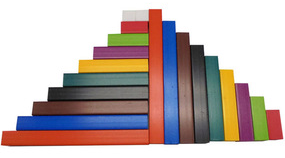
Use Cuisenaire Rods to explore relationships between quantities. Cuisenaire rods were invented in the 70’s by a Belgian math teacher, and they are more powerful than they seem at first. If you don’t have them, you can print your own here (please note, these cost $3.00 on Teacher Pay Teacher). You can use Cuisenaire rods to teach everything from counting to algebra. I put Cuisenaire rods at the end because there are just so many things you can do with them. Examples of things you can do are:
- Take one of the longer rods and find all the different ways you can make that rod with other rods. Try making the longer rod with only two other rods, and then also with more rods (like 3 or 4). Then try doing the same thing with doubles of a rod (for example, can you make a train the same length as two orange rods with other rods?). You can also look at multiples and common factors — for example, lay out a row of purple rods, and then make a train the same length with red rods. Explore making trains of all one type of rod to see when they do and don’t match up with trains of other color rods.
- Take two rods that add up to longer than an orange rod. Make a train the same length using one orange rod and another rod. Notice the overlap between of where the orange rod includes some of the length of the second rod. This is called “bridging through ten,” and to be honest, even as an adult, this is not something I do automatically.
- Take any three blocks and see how many ways you can put them together (i.e. white, red, green. Green, red, white. White, green, red, etc). How many different combinations can you make? If you have four blocks, how many different combinations can you make?
- If you are as in love with Cuisenaire rods as I am, you can also explore the resources posted by Sarasota County Schools.
If you’re going to start with one mathy game, I highly recommend “How Close to 100?” Trying it for a few days might also stimulate the natural curiosity to think, “what other ways can I play with math?”
PS When I asked my math teacher friend for feedback on this post, they shared five additional resources (one of which was a list of 30 more resources…)! But I’ll save those for a second post!