Children and Youth Should Not be Graded on Anything Right Now
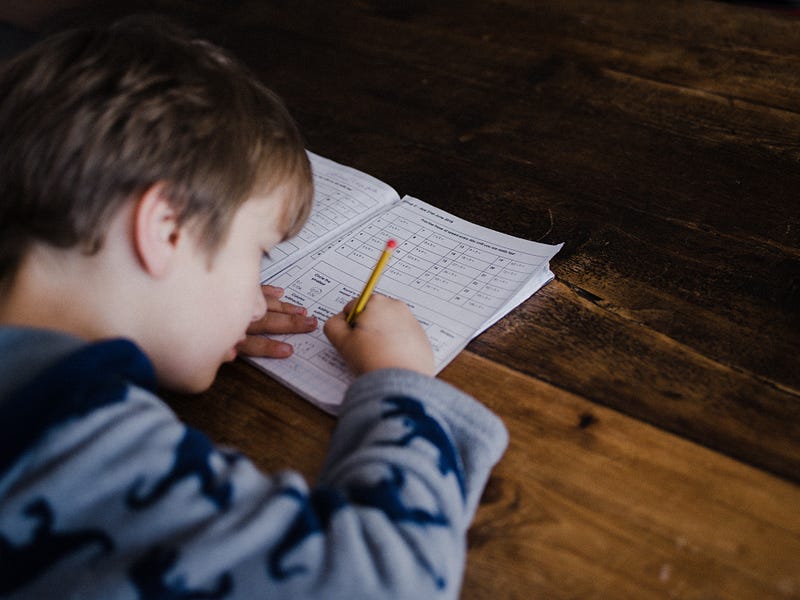
My nine year old son told me a story last night while we were lying in bed. He is on grasshoppers right now, and he narrated the story as a grasshopper who is traveling through a park. First he meets a bee who is looking for food. The grasshopper tells the bee, “You can find flowers over there.” Then he meets a lady bug who is looking for food: “You can find some aphids over there.” The story went on through four or five more insects with instructions on where to find their specific food needs. Then the grasshopper found a field of grass, ate lots of food, went home to their house, got married, had kids, and lived a nice life. ~The End~
What does this story tell me, other than that my son has an encyclopedic knowledge of animals? It tells me that he is thinking about and processing the concept of food insecurity. We as a family are not in a dangerous situation and he has not witnessed any grocery stores with empty shelves. He also is only watching age-appropriate news. We are not wealthy but have a great deal of privilege to not be impacted in a devastating way by the world wide COVID-19 crisis.
And yet my son is worried enough about food insecurity — for others and possibly for himself — that he is making up stories about insects helping each other to survive it.
Can you imagine what children and adolescents who are actually dealing with food insecurity are feeling? Or what about young people who have sick parents and grandparents? Or whose parents are working in places where they are constantly exposed to risk, in grocery stores or in hospitals? Or whose parents lost their jobs, like 22 million Americans? Or who are taking on more responsibilities by staying home, exhausting them just like parents are getting exhausted, like this young woman so eloquently wrote?
This is why no young people should be graded right now.
I believe that educators have a very important role to play in supporting families during the pandemic. But we need to be thinking about children and adolescents holistically, not focusing on trying to make things as “normal” as possible by recreating problematic school norms at home.
- This is the time to focus on that social and emotional learning teachers have to squeeze into their day. Helping students learn to name, understand, process, and release emotions will help them get through this and go back to school in September ready to learn. The Atlas of Emotions is an excellent tool for this.
- Children need structure but hours of virtual school is not going to work for most families. Educators need to trust that families know how much structure their children need and educators need to work with the different needs of families. Forcing children to sit through synchronous online lessons feels like it is more about controlling what young people do with their time than about learning. Instead of spending hours and hours prepping lesson plans that will not completed by many students, teachers should have time freed up to provide coaching to families based on individual needs.
- Just because school skills do not progress as much as we might want right now, that does not mean that children are not learning. There is a big difference between learning knowledge, problem solving skills, and school skills. School skills — like writing, arithmetic, and attention span — are important but they just aren’t as important at this moment in time. I mean that as a literal factual statement, not a judgement — if a child is not in school, it isn’t as important for them to use skills they primarily use at school. But if children have the space to grow in knowledge and problem solving skills, they are still growing and learning. When children go back to school, their teachers can help them figure out where they are and where they need to go with the school skills.
- Too much school work may be inadvertently driving lots and lots and lots of screen time. When students work really hard on their school work, while dealing with all the feelings in this completely abnormal situation, they are more likely to be spent afterwards and to just what to chill with video games or TV. Children need time and space to be bored (we know this) — if they spend their whole day doing school work at home, they don’t have time to get bored, just exhausted.
- Completing assignments at home is not the same as being at school. Children at school spend a lot of time listening and otherwise passively learning, in addition to transition time and breaks. Listening is not as energy-intensive as completing assignments! But sitting in your home, with lots of noisy people and all your toys in it , and trying to listen to instruction on a screen is not the same as being in a classroom. Homeschool is not school at home and quarantine school is not homeschool — so rather than trying to create either of those things right now, the focus should be on supporting families with finding their own grooves, and not prioritize external expectations. (I feel the same way about parents who are trying to work full time right now. Employers expecting optimal productivity should be ashamed of themselves. And that includes schools!)
- Technology is a huge pain in the ass, and it takes time to get in a groove. I’ve seen a lot of people posting about how now, after their kids being home for a few weeks, the school is setting up a whole new virtual learning system. Like in my family, it took people a few weeks to get in a groove at home, and now the school wants to change everything. If it took the school a few weeks to be ready with a good distance learning plan, it is absolutely unreasonable to expect families to be able to pivot instantly. It is not reasonable for schools to expect families to jump on the virtual school wagon and absolutely not reasonable to judge or make assumptions about those who don’t.
One more thing about technology — I have seen people repeating on social media “if they can figure out YouTube, Tiktok, and Instagram, they can figure out how to turn in an assignment.” Really??? This is so wrong. Youtube, TikTok, and Instagram are simple and user friendly. Three year olds can use them. You also control your own account. The electronic learning tools students are using, sometimes for the first time, are administered by someone at school and these software platforms are nowhere near as user friendly as social media. The people administering the software are often teachers with their own classes, are not normally IT tech support, and are not able to fix issues immediately.
It sounds like some schools are doing a great job, are providing flexible support from a holistic perspective, and are also helping families to keep their kids engaged in learning in a way that is supportive to this whole parenting in a pandemic thing. But I am also seeing posts about schools grading everything, how kids would be working harder if they were in school (they wouldn’t!), and a whole lot of assumptions about children and parents.
Let’s please call a pause and stop that? There are more important things to focus on than grades.