Sewing Badly in the Time of COVID-19
Apparently, my stress reaction to the pandemic is to sew.

It started with making masks. The first mask took me three hours, and I broke three needles. I’ve never been good at sewing. Then I figured out what was wrong, and have only broken one needle since when I forgot that my sewing machine couldn’t handle a zig zag (no zig zag!! Not worth it!). I made masks from a package of quarter yards of fabric that come in a cute little bundle (fat quarters) and a ripped bed sheet. I’ve kept a few masks for my family, given a few away, and have some still sitting unfinished by my sewing machine on one end of my dining room table.
But then I had scraps from the fat quarters. So I made them into little patchwork houses, which I (quite badly) sewed into a flannel-backed apron that can be gathered up for picking vegetables.

I paid way too much for some heavy, silky linen that makes me feel beautiful when I wear it with my brown boots. In one day, I bought it, washed and dried it, failed at ironing it, and sewed it into a circle skirt with an unfinished hem. I love the weight, the color, the texture, and the rough edges.
Maybe I’ll go back and add some embroidery to the bottom, but I like wearing it the way it is, with a simple white line protecting my skirt from the chaos of a fraying hem. I forgot that it’s actually important to finish your seams (hard without a zig zag stitch!), and probably need to go back and fix that too.
This, apparently was only the beginning, because I have decided to reacquaint myself with quilting, something I love, but have only done a few times. No one in my family sews. My mother gave me one misshapen flannel night gown. After my unfortunate apron incident, I understand why she quit. Flannel is a bitch. My grandmother considered it a tragedy if a button fell off, and the item either went to the tailor or in the garbage. They have other domestic skills — my mother is a master gardener, among other things, and my grandmother was a master chef and general bad ass — but the few times I decided I wanted to make something functional from fabric, I had no one to help me.
That was before I found the Quaker ladies who gather each year at Powell House, in upstate New York, to take over the Meeting Room with sewing machines, fabric, and quilt batting, that they generously share with those of us who wander in, not knowing what we are getting into.
In a Quaker Meeting House, the Meeting Room is the equivalent of the church sanctuary, and this quilting experience is very much an example of Quaker practice.
During these weekends, the experienced quilters allow the Light in them to speak with the Light in the rest of us, and we curse at sewing machines together, in a spirit of love, community, and mutual encouragement. I’ve attended two creativity weekends at Powell House, and during them I learned how to troubleshoot when you pull an impossibly large lump of thread out the bowels of your sewing machine, even though I am still a novice in the esoterica of thread tension. I learned to trust my color choices. I learned that you only need a little bit of each type of fabric, and if something isn’t quite right, you can fudge it.
Quilting is a tradition built on women turning garbage into art.
In the United States the quilting tradition is especially rich among African American and First Nations women, who for generations have taken the tiny left over bits and turned them into warmth and comfort. Other women who didn’t have a lot have also carried this tradition forward — including women in England who could make use out of a piece of fabric the size of a postage stamp, tacking it to a paper template and building incredibly intricate patterns.
It’s actually quite relaxing to baste scraps to the paper while on video conferencing calls.

Quilting is a tradition that comes from women turning garbage into art. It doesn’t have to be perfect. The bumpy seams that happened because my bobbin thread wasn’t quite right? Those are completely hidden among countless other seams. I don’t have to have the perfect fabric, I can piece things in small little bits and together they are beautiful. I don’t have to do it all at once, I can work on it when I’m able to, and leave it alone when I just can’t. My children can help, and we can talk about life while I try to make something that will warm them up.
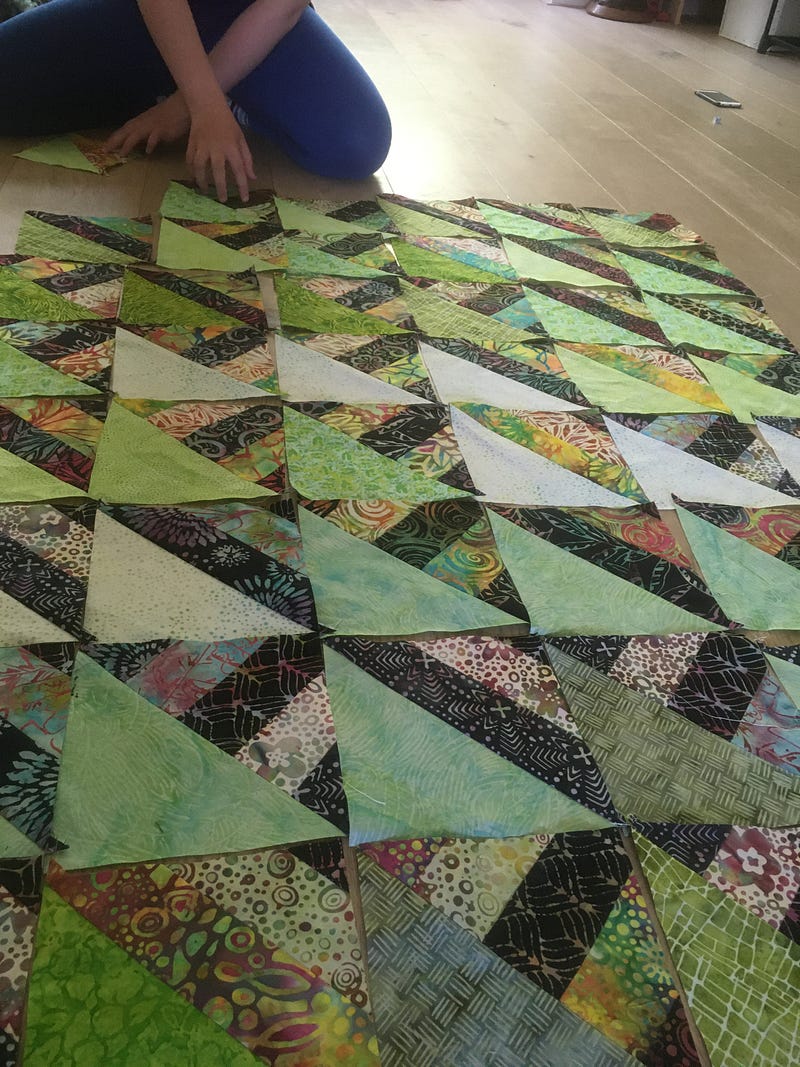
I have a lot of other things I need to do right now beyond my normal activities of running a business and raising a family. Keeping everyone safe and healthy, supporting my children’s education, maintaining contact with people I can’t just go and see, and calming so much anxiety, even from the people who aren’t normally anxious. I’m doing the best I can.
The sewing helps, especially because it doesn’t have to be perfect.